Our editorial standard: Every article on HealthyLife Remedy is written by a credentialed author and reviewed by an appropriate clinician before publication. We cite peer-reviewed research, not other health blogs. Meet the review team.
Adaptogens are a class of herbs believed to help the body maintain equilibrium under physical and psychological stress. The concept was formalized by Soviet pharmacologist Nikolai Lazarev in 1947. Western medicine was slow to take it seriously, but human clinical trial evidence has grown substantially over the past 15 years. That said, as this list shows, the evidence is genuinely stronger for some herbs than others. We've ranked these by evidence quality, not popularity, and noted where the research is thin so you're not misled either way.
If you're dealing with chronic vs. acute stress or specifically trying to lower cortisol naturally, this list will tell you which herbs actually have trial data behind them and which are riding on tradition alone.
Why this matters right now: the U.S. Centers for Disease Control and Prevention's National Health Interview Survey found that more than 13% of Americans aged 12 and older reported depression symptoms in 2021 to 2023, and roughly 5.7% of U.S. adults were living with serious mental illness in 2023. That demand backdrop has pushed the global adaptogen supplement market past an estimated $12 billion in 2025, according to industry market research. This is exactly why quality and evidence vary so widely from brand to brand, and why it's worth knowing what's actually been tested before you buy.
Evidence strength at a glance
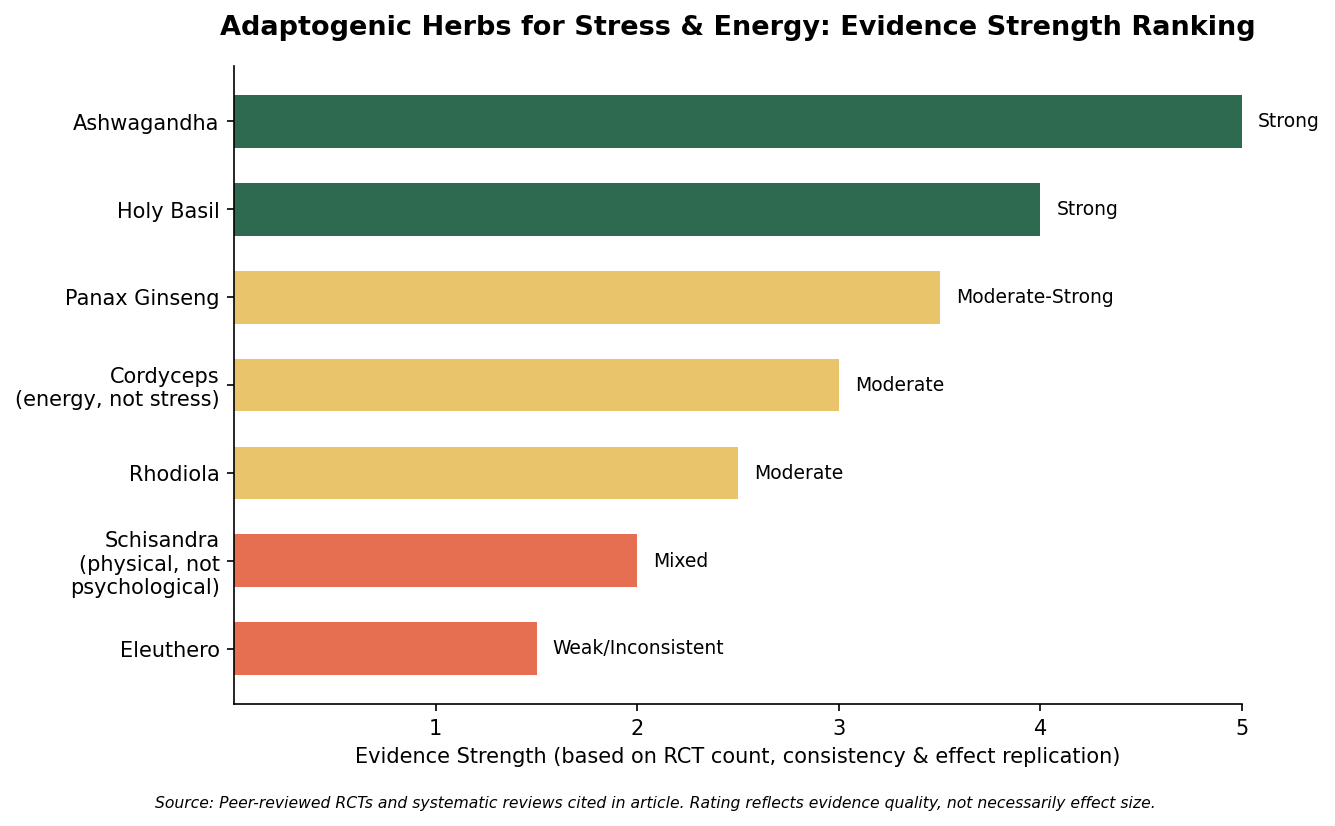
Ashwagandha — best-supported use: stress, anxiety, cortisol. Study type: meta-analysis, 9 RCTs (n=558). Typical dose: 300–600 mg/day.
Holy Basil — best-supported use: stress, cortisol, sleep. Study type: single RCT, 8 weeks. Typical dose: 300–600 mg/day.
Panax Ginseng — best-supported use: occupational stress. Study type: single RCT, 6 weeks. Typical dose: 200–400 mg/day.
Cordyceps — best-supported use: physical energy, not mood. Study type: multiple RCTs. Typical dose: 1–3 g/day.
Rhodiola — best-supported use: mental fatigue (mixed). Study type: systematic review, 11 RCTs. Typical dose: 200–400 mg/day.
Schisandra — best-supported use: physical fatigue, not mood. Study type: single RCT. Typical dose: 1,000–2,250 mg/day.
Eleuthero — best-supported use: traditional use, RCTs largely negative. Study type: RCT (n=144), negative. Typical dose: not recommended pending better data.
1. Ashwagandha (Withania somnifera): Strongest Evidence
The best-studied adaptogen by a wide margin. A 2024 systematic review and meta-analysis pooled nine randomized controlled trials (558 patients total) and found ashwagandha significantly reduced scores on the Perceived Stress Scale, the Hamilton Anxiety Scale, and serum cortisol compared to placebo. A separate, frequently cited 2019 randomized controlled trial (60 adults, 240 mg/day of a standardized extract) found a statistically significant reduction in morning cortisol versus placebo (p < .001).
Typical dose: 300–600 mg/day of root extract. Look for KSM-66 or Sensoril, both well-standardized, third-party-tested extracts used in the clinical trials above.
2. Holy Basil / Tulsi (Ocimum tenuiflorum): Strong, Specific Evidence
A 2022 randomized, double-blind, placebo-controlled trial (Lopresti et al., Frontiers in Nutrition) found that 8 weeks of a standardized Holy Basil extract significantly lowered hair cortisol (a marker of longer-term stress exposure), reduced salivary cortisol response to an acute stress test, and improved Perceived Stress Scale scores compared to placebo. It's one of the more rigorous single-herb adaptogen trials published in the past five years, and the same trial found sleep-quality improvements. If disrupted sleep is part of your stress picture, see our sleep hygiene guide for the non-herbal fundamentals first.
Typical dose: 300–600 mg/day of standardized extract. Also usable as tea, which is a practical advantage over capsule-only herbs.
3. Panax Ginseng: Solid Evidence, Dose-Dependent
A 2019 randomized, double-blind, placebo-controlled trial (Baek et al., Journal of Ginseng Research) gave Korean Red Ginseng to adults reporting high occupational stress over 6 weeks and found measurable improvements versus placebo. Effects are dose-dependent: most positive trials use extracts standardized to a defined ginsenoside content rather than raw powder.
Typical dose: 200–400 mg/day, standardized to ~4% ginsenosides. Avoid taking late in the day, since it can interfere with sleep in some people.
4. Rhodiola Rosea: Promising but Inconsistent Evidence
Often marketed as the fastest-acting adaptogen for burnout, and there's a real mechanistic case for it. But the most rigorous systematic review to date (Ishaque et al., 2012, screening 206 studies down to 11 qualifying trials) concluded the evidence is genuinely mixed: only 3 of 5 trials evaluating mental fatigue showed significant improvement, and the review flagged high risk of bias across most of the included studies. That doesn't mean it doesn't work. It means the evidence is weaker than popular wellness content usually suggests.
Typical dose: 200–400 mg/day, standardized to 3% rosavins and 1% salidroside.
5. Schisandra Chinensis: Evidence Is for Physical, Not Psychological, Stress
Schisandra's best human evidence is narrower than commonly claimed. A 2020 randomized, double-blind, placebo-controlled trial in adult women found 1,000 mg/day of Schisandra extract over 12 weeks improved quadriceps muscle strength and reduced a physical fatigue marker (resting lactate), a real, measurable effect, but on physical performance, not mood or perceived psychological stress. If you're specifically looking for anxiety or cortisol reduction, this isn't the best-supported choice on this list; ashwagandha and holy basil above are.
Typical dose: Most trials use 1,000–2,250 mg/day of standardized fruit extract.
6. Eleuthero / Siberian Ginseng (Eleutherococcus senticosus): Mixed, Some Negative Trials
Eleuthero has one of the longest traditional-use histories of any adaptogen: it was issued to Soviet cosmonauts and Olympic athletes. But the modern clinical picture is more cautious than the tradition suggests. A well-designed 2013 randomized controlled trial (144 participants with stress-related fatigue) found no additional benefit from adding eleuthero to a stress-management training program, and an earlier trial found no benefit for chronic fatigue syndrome specifically. It's not disproven, but it's the herb on this list with the least consistent supporting evidence, and it's worth knowing that before paying a premium for it.
7. Cordyceps (Cordyceps militaris / sinensis): Good Evidence for Energy, Not for Stress Specifically
Cordyceps is a medicinal mushroom, not a plant, but it's consistently grouped with the classic adaptogens. Its human evidence is real and reasonably consistent, but it's evidence for physical fatigue and exercise capacity, not psychological stress relief, so it earns its place on this list under the "energy" half of the title, not the "stress" half. A double-blind, placebo-controlled trial in healthy older adults found improved exercise performance markers with Cs-4 extract over 12 weeks. A 2024 randomized trial found an 8-week Cordyceps militaris beverage measurably increased natural killer (NK) cell activity in men. Worth being upfront about a limitation too: a 6-week randomized trial testing Cordyceps militaris as an add-on to depression treatment found no significant improvement in sleep or depression scores over placebo, so this isn't one to reach for if you're expecting a mood or anxiety effect.
Typical dose: Most trials use 1–3 g/day of standardized Cs-4 extract or fruiting body powder.
FAQ
Are adaptogenic mushrooms the same as adaptogenic herbs?
Not botanically. Cordyceps, along with others like reishi and lion's mane, is a fungus, not a plant, so "adaptogenic mushroom" is technically the more accurate term for it. It's grouped with adaptogenic herbs like ashwagandha and rhodiola because it's used for the same purpose (stress and fatigue resistance) and shares the non-toxic, HPA-axis-modulating criteria that define an adaptogen. If you're specifically shopping for mushroom-based options, look for cordyceps, reishi, and lion's mane rather than root or leaf extracts.
What is the best adaptogenic herb for stress?
Based on current clinical trial evidence, ashwagandha and holy basil have the strongest, most consistent human research support for reducing perceived stress and cortisol. Rhodiola and Panax ginseng have supportive but more limited evidence; eleuthero's evidence is the weakest of the commonly recommended adaptogens.
Can adaptogenic herbs actually lower cortisol?
Yes, some can. Ashwagandha and holy basil have both shown statistically significant cortisol reductions in randomized controlled trials. See our full breakdown of foods and herbs that lower cortisol naturally for a broader dietary approach alongside these herbs.
What is the most powerful adaptogen?
There's no single "most powerful" adaptogen. It depends what you're targeting. For stress and anxiety specifically, ashwagandha has the largest and most consistent evidence base. For physical energy and exercise capacity, cordyceps and Panax ginseng have the better data. Be skeptical of any single herb marketed as universally "the most powerful."
Are adaptogens safe to take together?
Most of the herbs above have reasonable safety profiles individually, but combination products are far less studied than single herbs, and quality varies widely. A 2025 laboratory study of adaptogenic supplements sold in Poland found several products exceeded safe limits for lead and nickel contamination. Buy from brands that publish third-party lab testing, and talk to a healthcare provider before combining herbs, especially if you take medication or have a cardiovascular or endocrine condition.
How long does it take for adaptogens to work?
This varies by herb and by outcome measured. Ashwagandha and holy basil trials generally measured effects at 6–8 weeks of daily use. Some people report subjective effects sooner, but the controlled trial data is based on weeks of consistent use, not single doses. Herbs work best alongside, not instead of, foundational habits. If gut health is part of your stress picture, see our guide on the gut-brain connection and anxiety.
Medical Disclaimer: This article is for informational purposes only and does not constitute medical advice. Consult a qualified healthcare provider before making changes to your health routine, especially if you have an existing medical condition or take medications.
Related Articles
Hormonal Acne: Natural Remedies With Evidence Behind Them
Cortisol Belly Fat: The Real Science Behind Stress and Stubborn Abdominal Fat
Cortisol Face Is Real: 7 Natural Ways to Lower Cortisol
Sources
Effects of Ashwagandha (Withania Somnifera) on stress and anxiety: A systematic review and meta-analysis. Journal of Ethnopharmacology, 2024.
Lopresti AL, et al. An investigation into the stress-relieving and pharmacological actions of an ashwagandha extract. Medicine, 2019.
Lopresti AL, et al. Effects of an Ocimum tenuiflorum (Holy Basil) extract on stress, mood, and sleep. Frontiers in Nutrition, 2022.
Baek JH, et al. Effect of Korean Red Ginseng in individuals exposed to high stress levels. Journal of Ginseng Research, 2019.
Ishaque S, et al. Rhodiola rosea for physical and mental fatigue: a systematic review. BMC Complementary and Alternative Medicine, 2012.
Park J, Han S, Park H. Effect of Schisandra chinensis Extract Supplementation on Quadriceps Muscle Strength and Fatigue in Adult Women. Int J Environ Res Public Health, 2020.
Schutgens FWG, et al. No benefit adding eleutherococcus senticosus to stress management training.
Ontawong A, et al. A randomized controlled clinical trial examining the effects of Cordyceps militaris beverage on the immune response in healthy adults. Scientific Reports, 2024.
Heavy Metal Contamination in Adaptogenic Herbal Dietary Supplements.
CDC National Health Interview Survey, 2021–2023 depression prevalence data.