What Is Febrile Illness?
Febrile illness meaning, in plain terms, is any illness accompanied by a fever. The word "febrile" comes from the Latin febris, meaning fever, and doctors use it as shorthand to describe a patient's condition rather than naming a specific disease. So when a chart says "febrile illness," it means this person has an elevated body temperature as part of whatever is going on with their health.
What is febrile illness, exactly, in numbers? The CDC generally puts the threshold at a measured temperature of 100.4°F (38°C) or higher, and also counts someone as feverish if they appear noticeably warm or report feeling feverish even without a thermometer handy. Below that threshold, even if someone feels warm or unwell, they're technically not considered febrile.
Febrile illness isn't a diagnosis on its own. It's a description. The actual cause could be anything from a common cold to a urinary tract infection to something more serious, which is why doctors distinguish between acute and chronic presentations.
Acute vs. Chronic Febrile Illness
Acute febrile illness refers to a fever that comes on suddenly and lasts a short period, generally under one to two weeks. This is the most common pattern, usually tied to:
By contrast, a chronic or prolonged febrile illness, sometimes called a fever of unknown origin (FUO), is one that persists for more than two to three weeks without a clear cause identified after initial testing. This pattern is far less common and usually prompts a deeper medical workup for things like autoimmune conditions, chronic infections, or, rarely, certain cancers.
For most people searching "acute febrile illness," the concern is the everyday version: a fever that showed up recently and needs to be understood and managed. Staying hydrated and tracking your symptoms as they change matters throughout the illness. Our free Wellness Toolkit can help you log temperature readings and stay on top of hydration while your body fights it off.
Common Symptoms That Come With Fever
A fever rarely shows up alone. It tends to bring a cluster of symptoms with it, and recognizing the pattern can help you gauge how concerned to be.

Hot and Cold Spells
Hot and cold spells, feeling overheated one moment and shivering the next, are one of the most common and confusing fever symptoms. This happens because your hypothalamus (the brain's internal thermostat) resets to a higher target temperature during infection. Your body then shivers and constricts blood vessels to reach that new, higher setpoint (the cold or chills phase), and once it gets there, you feel hot and may start sweating as the body works to cool back down.
What causes hot and cold spells beyond infection can include:
If hot and cold spells appear with no actual fever reading, it's worth tracking your temperature over a day or two to see whether an underlying fever is present but fluctuating, or whether another cause is more likely.
Burning Up With Fever
The feeling of burning up with fever, that intense radiant heat especially across the face and torso, typically peaks once your temperature has reached its new setpoint and your body is actively dissipating heat. It's uncomfortable but not inherently dangerous unless the underlying temperature is very high (see hyperpyrexia below).
Some people report burning up with no fever, meaning they feel overheated without a thermometer confirming it. This can happen with:
Fever Patterns: Sustained, Intermittent, and Low-Grade
Not all fevers behave the same way, and the pattern a fever follows can actually help identify its cause.

Tracking whether a fever is sustained, intermittent, or low-grade, and noting when it spikes, gives a doctor useful diagnostic information if the illness doesn't resolve quickly. The Wellness Toolkit's tracker makes it easy to log readings over a day or two and spot the pattern yourself.
Visual Guide: The Fever Scale
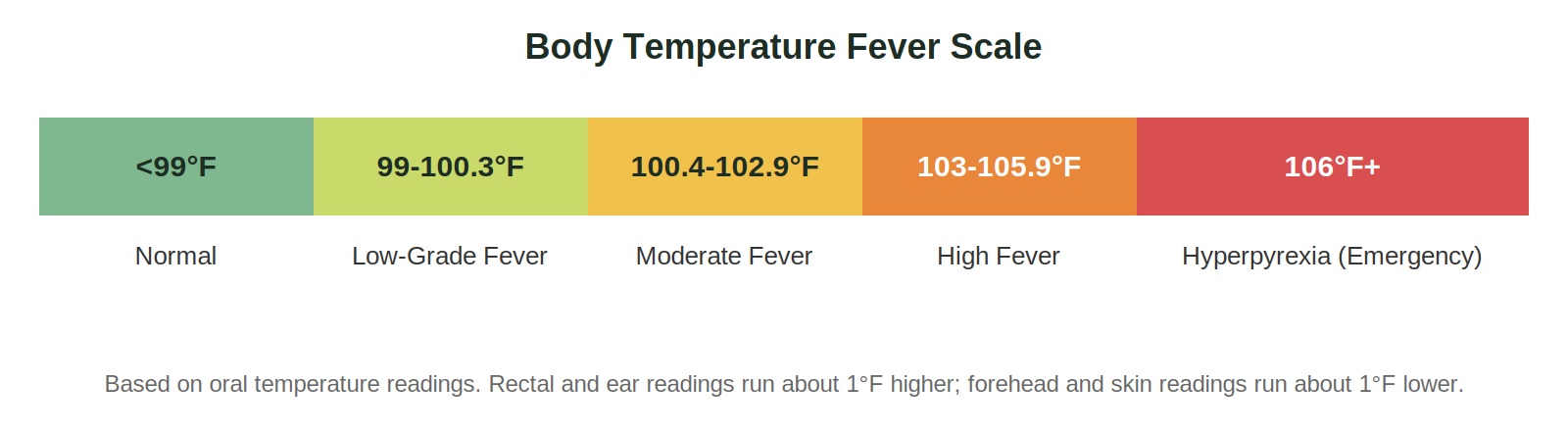
Here's how body temperature readings break down, from normal through medical emergency:
When Fever Becomes Dangerous: Hyperpyrexia
Hyperpyrexia symptoms describe a medical emergency: a very high fever, typically above 106°F (41.1°C). This is far beyond a routine fever and requires immediate medical attention. Heat-related versions of this emergency, such as heatstroke, can begin at temperatures as low as 104°F (40°C), per the Mayo Clinic.
Signs and symptoms of hyperpyrexia can include:
Hyperpyrexia can result from severe infections, heatstroke, certain drug reactions, or rare neurological conditions. Unlike a standard fever, it isn't something to manage at home. It needs emergency care.
Afebrile: The Opposite of Fever
You may also come across the term afebrile in medical notes or lab results. The afebrile medical definition is simply "without fever," meaning a temperature within the normal range, generally below 100.4°F (38°C).
What does afebrile mean in practice? If a chart says a patient is "afebrile," it means their temperature is normal at that point in time, which doesn't necessarily mean they're fully well, just that fever isn't currently part of the picture. Someone can be afebrile between fever spikes in an intermittent fever pattern, for example, or afebrile while still recovering from an illness.
One specific and important term is afebrile convulsions (also called afebrile seizures), which are seizures that occur without an accompanying fever. This distinguishes them from febrile seizures, which happen specifically during a rapid rise in body temperature and, according to MedlinePlus, occur most often in otherwise healthy toddlers and young children. Afebrile seizures point toward a different underlying cause, such as epilepsy, and are evaluated differently by physicians than febrile seizures.
Running a Temperature: What Counts as a Fever?
"Running a temperature" is simply everyday language for having a fever. If you're wondering whether your specific number counts:
| Below 99°F (37.2°C) | Normal | 99-100.3°F (37.2-37.9°C) | Low-grade fever | 100.4-102.9°F (38-39.4°C) | Moderate fever | 103-105.9°F (39.5-41°C) | High fever | 106°F+ (41.1°C+) | Hyperpyrexia (emergency) |
Note that certain conditions, like pneumonia, can sometimes present with only mild temperature elevation or none at all, especially in older adults, so a normal reading doesn't always rule out a serious infection if other symptoms are present.
When to See a Doctor
Most acute febrile illness resolves without intervention. But seek medical care if:

Frequently Asked Questions
What is febrile illness?
Febrile illness is any illness in which fever, meaning a body temperature of 100.4°F (38°C) or higher, is a defining symptom. It's a descriptive medical term, not a specific diagnosis.
What does acute febrile illness mean?
It means a fever with sudden onset that typically lasts less than two weeks, most commonly caused by a viral or bacterial infection.
What causes hot and cold spells?
Hot and cold spells usually occur as the body's internal thermostat resets during a fever, causing alternating chills and heat as the body works to reach and then dissipate a new, higher temperature setpoint.
What does afebrile mean?
Afebrile means "without fever," or a body temperature within the normal range, generally below 100.4°F (38°C).
What is considered a low grade fever?
A low grade fever is generally a temperature between 99°F and 100.9°F (37.2 to 38.3°C): elevated, but below the standard fever threshold.
What are hyperpyrexia symptoms?
Hyperpyrexia refers to an extremely high fever above 106°F (41.1°C), often accompanied by confusion, rapid heart rate, seizures, or loss of consciousness. It's a medical emergency requiring immediate care.
Are afebrile convulsions serious?
Afebrile convulsions (seizures without fever) warrant medical evaluation, as they can indicate epilepsy or another underlying neurological condition, unlike febrile seizures which are fever-triggered and typically less concerning in young children.
This article is for general educational purposes and isn't a substitute for professional medical advice. If you're concerned about a fever or related symptoms, consult a healthcare provider.
Sources: CDC: Definitions of Signs, Symptoms, and Conditions of Ill Travelers · Cleveland Clinic: Fever · MedlinePlus: Febrile Seizures · Mayo Clinic: Heatstroke, First Aid